Roquecourbe · Tarn · South of France
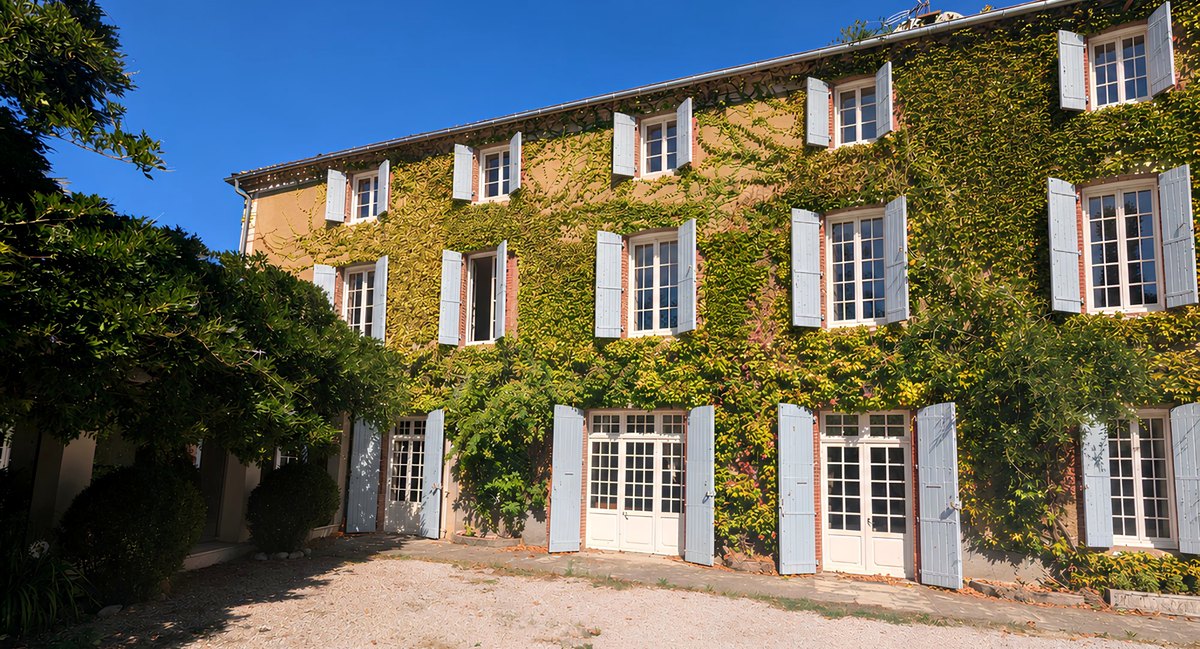
A French manor
house, and its
own park.
625 m² over three floors. Ten bedrooms. A walled park of mature trees, three garages and a laundry room — and the baker, the market and the doctor fifty metres from the gate.
Why this house is unusual
Space, character
and a village.
Rarely all three.
Most large French houses at this price are isolated: a beautiful shell twenty minutes from the nearest loaf of bread, and a winter that feels very long. This one sits in the middle of a village of 2,200 people that lives all year round — behind its own gates, screened by a park of mature trees on 3,345 m² of grounds.
Original throughout
The staircase, the parquet, the marble fireplaces, the panelling and the fitted library are all original and have been looked after, not stripped out.
Everything on foot
Bakery, grocer, weekly market, pharmacy, doctors' surgery, café, restaurant, school, river. You will use the car far less than you expect.
South-facing, all of it
Every principal room and every bedroom faces south over the park. In this part of France that means light from February to November.
Lived in, with costed work ahead
The house is occupied and heated — you can move in. It then needs bringing up to date: insulation, wiring, bathrooms. The surveys put figures on all of it, and those figures are on this page.

The price
€550,000.
€880 per square metre.
The easiest claim on this page to check for yourself. Here is what comparable maisons de maître are currently being asked for in the Tarn.
Why it is priced this way
We are selling the house ourselves. On a sale of this size a French agency commission is commonly €25,000–€30,000, and it is normally built into the asking price. It is not in ours.
The rest is arithmetic: very large houses always sell for less per square metre than small ones. We would rather set an honest figure and sell than set a hopeful one and spend six months negotiating down to it.
For a northern European buyer
€550,000 buys a two-bedroom flat in most of Amsterdam, Brussels, Copenhagen or Stockholm. Here it buys ten bedrooms, three reception rooms, three garages, a wine cellar and four-fifths of an acre of walled grounds, in a village with a market.
For British buyers: roughly £470,000 at late-2026 exchange rates, for 6,727 sq ft — about £70 per square foot. Check the rate on the day; sterling moves.
Add roughly 7–8% for French notary fees and transfer duties — about €40,000 — and that is the full cost of purchase. There is no agency commission, and no stamp duty surcharge for foreign or non-resident buyers in France.
Comparison sources: asking prices for maisons de maître listed for sale in the Tarn on Belles Demeures, September 2026, divided by their stated floor area; commune averages from MeilleursAgents and PAP as at 1 September 2026. Asking prices are not achieved sale prices.
Inside
Three floors,
625 m² of living space.
Reception rooms on the ground floor, six bedrooms on the first, four on the second, a large attic above. Ceiling heights and volumes that nobody builds any more.
Ground floor
The reception rooms

- Main drawing roomTwo full-height glazed doors to the park50.5 m²
- Garden room / gymGlazed wall onto the park38.1 m²
- KitchenLarder, fitted storage, cloakroom adjoining30.8 m²
- Small drawing roomMarble fireplace, parquet25.9 m²
- Study / libraryPanelled, with fitted bookcases22.4 m²
- Entrance hallMain staircase, cloakroom18.3 m²
- Dining roomOpening off the drawing room17.3 m²
- Wine cellarStable temperature year-round≈15 m²
First floor
Six bedrooms · four with private bath or shower roomA wide central corridor serves the bedrooms, all of them facing south over the park. This is the layout of a house built to receive people: you move through it without crossing rooms, and every bedroom closes on itself.


- CoconPrivate bathroom · corner bath, twin basins, WC24.3 m²
- JardinWindow and door to a private terrace21.3 m²
- MajestéPrivate shower room21.2 m²
- AzurPrivate shower room · two windows18.0 m²
- ÉglantinePrivate shower room17.7 m²
- EmpireFull bathroom adjoining — roll-top bath, shower, WC17.5 m²
Second floor
Four bedrooms · the same layoutThe same principle one floor up: a broad corridor fitted with cupboards serves four bedrooms facing the park, one of them with its own shower room and WC. A large attic completes the level.
- BedroomPrivate shower room and WC17.5 m²
- BedroomSouth-facing window15.7 m²
- BedroomOne window13.0 m²
- BedroomOne window12.6 m²
The distribution of bathrooms and shower rooms is as recorded in the valuation report of an expert attached to the Toulouse Court of Appeal; the room-by-room detail is sent on request. The bedroom photographs above are all of the first floor.
The park & outbuildings
A park of
hundred-year-old trees.
An avenue of mature trees across the front, lawns, clipped box, a flagged terrace and shaded walks, closed by a wall and an automatic gate. All of it in the middle of the village, on 3,345 m² of registered land across eight parcels. That combination is what makes this house hard to compare with anything else.
Three garages — about 100 m²
A range of three garages on the east side, roughly 100 m² in all, with a laundry room adjoining the house. Room for the cars, the bicycles and the garden tools.
Wine cellar — approx. 15 m²
Below ground, stable temperature all year.
Room for what comes next
Kitchen garden, greenhouse, boules court, outdoor dining — and a spot already identified for a swimming pool.


A hospitality project
Ten bedrooms,
in the middle of
a visited region.
Few buyers need ten bedrooms for themselves. This house has the size, the separate entrances and the location to take guests — and the Tarn has the visitors. After a family house, it is the most obvious thing to do with it.
Three configurations, from the simplest to the most ambitious
Five guest rooms,
without leaving your home
The house is laid out like a place built to receive people, which is rare: on each floor a wide central corridor serves the bedrooms, all of them facing south over the park. You move through it without crossing rooms, and every bedroom closes on itself.
More to the point, five bedrooms already have their own bath or shower room — four on the first floor, one on the second. That is the single heaviest cost in converting a house for guests, and it is already done.
French law caps chambres d'hôtes at five rooms and fifteen guests. You are therefore at the ceiling without spending a euro on conversion, and free to choose which five: keep whichever floor suits you and take guests on the other.
Shared living
for active older residents
The owners worked this one up in detail: private bedrooms, shared living rooms, pooled services — a warm alternative to isolation that leaves each resident their independence and their own front door.
The central-corridor layout and the private shower rooms make the house directly suited to it. The working file, with its assumption of €980 per room per month inclusive of charges, is sent on request.
The whole house,
let to groups
625 m², ten bedrooms, three reception rooms, a large kitchen and walled grounds: this is the format for family reunions, milestone birthdays, weddings and small corporate retreats — a segment short of large-capacity properties in the Tarn, and one whose season runs well beyond summer.
It is also the quickest to start: a meublé de tourisme is declared, optionally graded, and needs no heavy conversion.
Why here
The Sidobre, fifteen minutes away
The largest granite chaos in Europe, at the heart of the Haut-Languedoc regional park: walking, mountain biking, trail running, riding, fishing, the Lac du Merle.
Albi, 40 km
A UNESCO World Heritage episcopal city — Sainte-Cécile cathedral, the Palais de la Berbie and the Toulouse-Lautrec museum.
Castres, 8 km
The Goya museum, the old houses hanging over the Agout, and an airport fifteen minutes away with daily flights to Paris and Lyon.
And above all: the village
Your guests walk to the bakery, the café, the restaurant and the market. An isolated gîte means a car for every meal; this one does not. That is what brings back guests without a car — and cyclists.
What to check before committing
We are not going to sell you a yield. Here, instead, is what we know of the constraints, so that your figures are the right ones.
- Beyond five rooms it is no longer a chambre d'hôtes: the property falls under the rules for public-access buildings, with their fire-safety and accessibility standards.
- Insulation first. Hosting all year with an E-rated house shows up on the heating bill. The costed works above are the precondition for a year-round business.
- Tax and formalities: declaration at the mairie, tourist tax, the choice between micro-BIC and actual-cost taxation, professional insurance. None of this requires French residency.
None of it is an obstacle, but all of it needs preparing. The Roquecourbe mairie and the Tarn tourism development agency advise free of charge, and we will gladly put you in touch.
And if hosting is not your plan: the house was built and lived in as a large family house — entertaining on the ground floor, parents on the first, children and friends on the second, each behind their own door. That is how the present owners live in it.
The uses described here are possibilities, not income that has been earned or is guaranteed. The five-room, fifteen-guest cap on chambres d'hôtes is set by the French Tourism Code (articles L. 324-3 and L. 324-4). Take advice from the mairie and a French notary before committing.
The village & getting there
Everything on foot.
Home in half a day.
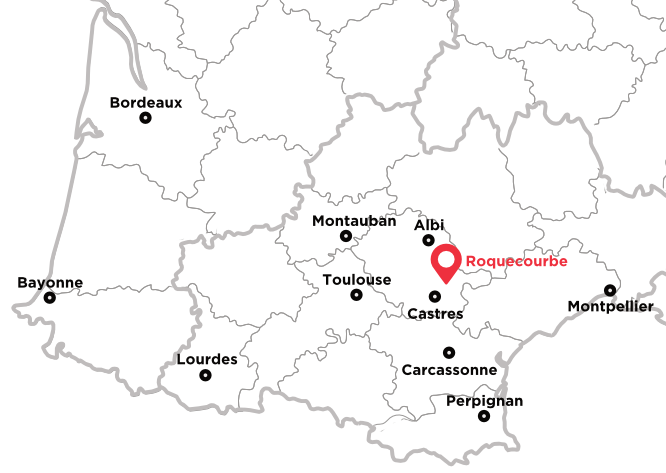
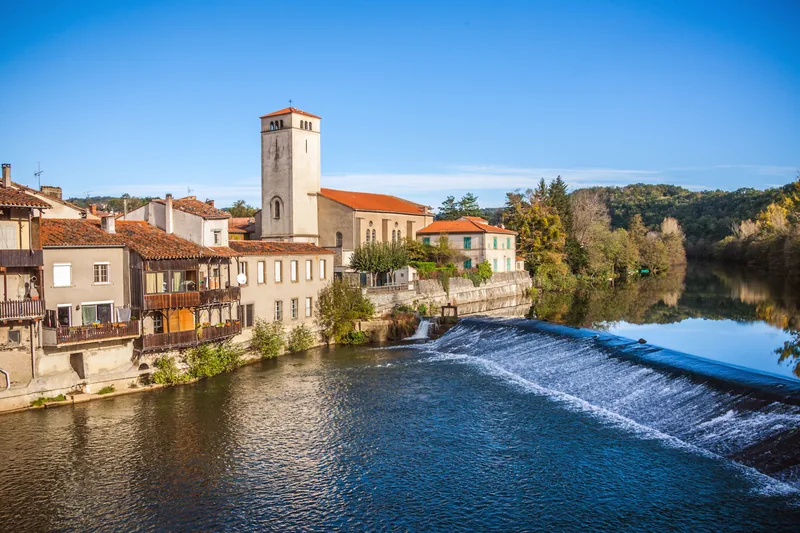
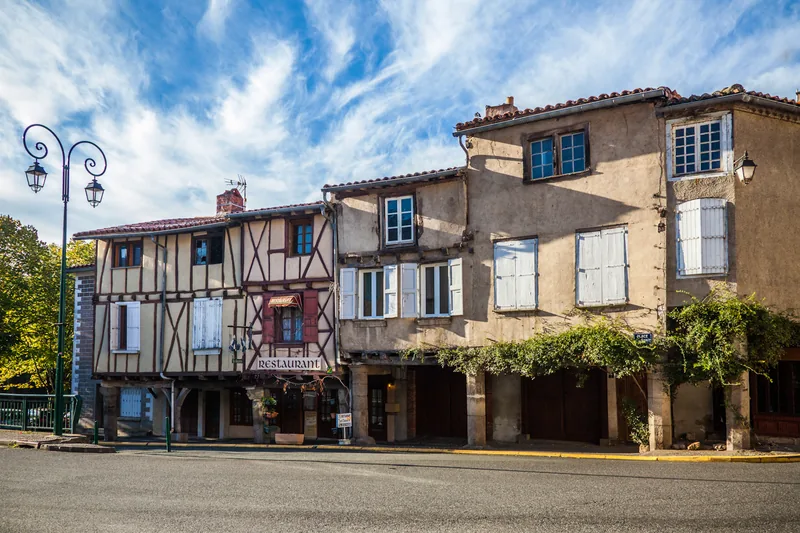
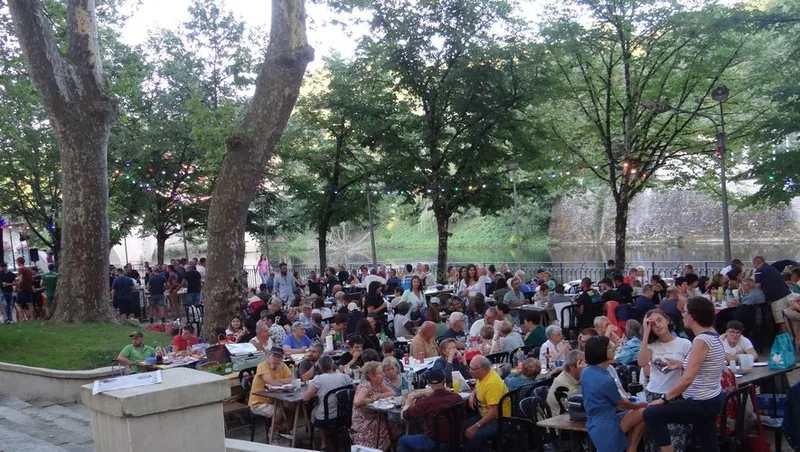
Roquecourbe, 2,200 people, on the river Agout at the gateway to the Sidobre. It has a market, a school and a doctor — which is what separates a country house you enjoy from a country house you sell again after three winters.
- Castres 8 km · 12 min
- Castres-Mazamet airport 15 km · daily Paris & Lyon
- Castres railway station 10 km
- Albi (UNESCO World Heritage) 40 km
- Toulouse 80 km
- Toulouse-Blagnac airport 90 km · ≈1 h 15
- Carcassonne airport ≈75 km · ≈1 h 10
- The Mediterranean ≈150 km · ≈1 h 45
Flying home
Carcassonne, just over an hour away, is the low-cost airport and the one most northern European owners here use: Brussels Charleroi, London Stansted, Manchester, East Midlands, Bournemouth, Dublin, Cork and Porto.
Toulouse-Blagnac, an hour and a quarter away, is the full-service option — a proper international airport with direct services to Amsterdam and Brussels, and, for British travellers, to London Gatwick, Heathrow and Stansted with British Airways, easyJet and Ryanair, plus a direct Bristol route. Heathrow matters if you are connecting onward or travelling with more than a cabin bag.
Castres-Mazamet, fifteen minutes from the gate, has daily flights to Paris and Lyon.
Driving is realistic too: Calais to Roquecourbe is a long day — and there are three garages at the end of it.
Road distances are indicative; figures to Castres, Albi, Toulouse and the airports are those published by the commune of Roquecourbe. Airline routes change seasonally — check before booking. The new A69 motorway between Toulouse and Castres is announced to open in full in mid-October 2026 and is expected to cut roughly twenty minutes off the Toulouse run.

The village in pictures
Gallery
26 photographs.
Click any image to enlarge. A visit is worth a thousand photographs — but it helps to know what you are travelling for.
Practical questions
Buying a house
in France, honestly.
You are dealing with the owners, not an agent. We answer plainly, including when the answer is not flattering.
E on both scales. In the French system that is neither a passoire thermique (F or G, which now carry letting restrictions) nor a well-insulated house. It is what you would expect of a pre-1948 stone building that has never been insulated — and it is the single biggest thing a buyer can improve. The costs of doing so are set out below.
Can a foreigner or a non-resident buy this house?
Yes, without restriction. France places no limit on nationality or residence for property purchase, and there is no surcharge for foreign buyers. The sale goes through a French notaire, a public officer who acts for the transaction rather than for either side, and you can give power of attorney if you cannot travel for signature. Most French banks lend to non-residents, usually against a larger deposit.
What are the total costs on top of the price?
Budget roughly 7–8% of the price in frais de notaire — transfer duties, the notary's fee and registration — which is about €40,000 here, payable by the buyer to the notary as on any French purchase.
What is different is that there is no agency commission, because there is no agent. The comparable properties listed above are advertised commission included; on a sale of this size that is commonly €25,000–€30,000 built into the price. Here it simply does not exist.
You will also want a French bank account and home insurance; a tax representative is not normally required for a purchase.
I hold a British passport. How long can I stay?
Owning property in France carries no residence right, and since Brexit a British passport holder is a third-country national in the Schengen area: 90 days in any rolling 180 without a visa. That is ample for a holiday house, and it is how most British owners use one.
To live here, or to run guest rooms, you need a long-stay visa — a visa de long séjour for residence, or an entrepreneur route if the house is to earn its keep, which means a business plan filed in French. It is entirely doable and thousands do it, but it is a real administrative project and we would rather you knew that from us than discovered it after the offer.
How does the process actually run?
You make an offer; we sign a compromis de vente before the notary, at which point you pay a deposit of around 5–10% into the notary's escrow account and a ten-day statutory cooling-off period runs in your favour. The notary then carries out searches, typically two to three months, and you sign the acte de vente and take the keys. Every mandatory survey — energy, asbestos, lead, termites, electrics, gas, drainage, natural risks — is paid for by us and handed to you at the compromis.
Can the sale fall through the way it does in England?
Not in the same way, and this surprises most British buyers pleasantly. In France the binding moment comes early: once the compromis de vente is signed, the seller is committed. We cannot accept a better offer afterwards, and there is no equivalent of gazumping.
The protection runs your way, not ours. You get a statutory ten-day cooling-off period after signing, during which you may withdraw for any reason and recover your deposit in full. Your offer can also be made conditional on a mortgage, and if the loan is refused the deposit comes back to you.
In short: after the compromis, you can still walk away and we cannot. That is the opposite of an English chain, and it is worth knowing before you compare the two processes.
How do I move the money across?
The purchase settles in euros, into the notary's escrow account, and the notary must have cleared funds before the final signature. If you are converting from sterling or another currency, plan that step early — a same-day bank transfer at a poor rate is an expensive way to end a purchase.
High-street banks usually apply a margin of 2 to 4% on the exchange rate, on top of any fee. Specialist currency firms typically quote closer to the interbank rate and allow you to fix a rate in advance — on a sum of this size the difference runs into thousands. We are not recommending any particular provider, and we take no commission from anyone; compare two or three, check they are FCA-registered, and ask about a forward contract if you want certainty between the compromis and completion, which is usually two to three months apart.
How is the house heated, and what does it cost to run?
Gas-fired central heating through radiators, with a condensing boiler installed in 2021 and a second, older gas boiler; hot water from a 200-litre cylinder off the heating system; a few electric convectors in support. No air conditioning.
The energy survey puts the annual running cost of the whole house at €8,180 to €11,100 (all uses, energy prices indexed to 1 January 2021). That is what a large, uninsulated old French house costs to run, and it is the first thing a buyer can change. We will give you our actual invoices for the last three years to anyone who visits or asks.
What is the annual property tax?
We will send you the exact figure from the most recent year, with the tax notice itself. France has two local property taxes: taxe foncière, paid by the owner, and taxe d'habitation, now abolished on main residences but still payable on second homes.
Is work needed?
Yes, and we would rather set it out than let you discover it. The house is lived in, heated and maintained — you can move in — but it needs bringing up to date, as any building of this age and size would.
The energy survey costs two levels of work: an essential package (internal wall insulation, ceilings and floors, mechanical ventilation, heating controls) at €52,000–€77,900; and a second package (air-to-water heat pump, double glazing, new joinery) at €100,400–€150,600. Rewiring should be added to that.
Against this, the structure is sound: stone walls, traditional timber roof frame, tiled roof in fair condition, and a condensing boiler installed in 2021. You are not buying a ruin to rescue; you are buying a house to modernise.
What do the compulsory surveys say?
French law requires a bundle of surveys, the dossier de diagnostic technique. Ours was carried out in January 2024 by a certified surveyor and we send it in full, unedited, to anyone who asks. In summary:
- Termites — no evidence of infestation.
- Gas — type A2 anomalies, to be repaired promptly.
- Electrics — an old installation with anomalies; rewiring is advised.
- Lead — lead-bearing paint above the threshold, which is normal in any pre-1949 French house.
- Asbestos — materials that may contain asbestos identified, notably the fibre-cement garage roof.
None of this is unusual for a house of this date, and none of it prevents you living there. But they are line items for your budget, and we would rather you had them before travelling than after.
How is the 625 m² measured?
We quote 625 m² (6,727 sq ft), from a room-by-room survey of the house across its three floors. The energy surveyor recorded 555 m² on the certificate of 8 January 2024 — you can see that figure on the energy panel above, and we are not hiding it.
The gap is a matter of method: the energy certificate counts only heated areas meeting its own criteria and excludes the attic floor and certain ancillary spaces. Certified measurement is not compulsory for a detached house in France — the loi Carrez applies only to flats — and we have not commissioned an independent one. If you want one before signing, we have no objection at all, and we will act on what it says.
The land is exact: 3,345 m² of registered area, section AM, parcels 30, 31, 103, 192, 242, 255, 257 and 259.
Can we view remotely before travelling?
Yes, and we recommend it if you are coming a long way. We will walk you through the whole house on a live video call, in English, room by room, at a time that suits you — showing what you ask to see, not a curated edit.
Is the furniture included?
The house is sold unfurnished, but a good deal of the antique furniture suits these rooms and can be bought separately by agreement. We are happy to discuss it.
Is the price negotiable?
€550,000 was set against the market and with no agency commission to absorb, so it is already a net figure. We will listen to any serious offer, but we have not inflated the asking price to leave room for haggling.
Do you speak English?
Yes. Write to us in English and we will answer in English, including on the video call and during your visit.
Next step
Come and see it.
A viewing takes about an hour and a half. We receive visitors whenever suits you, weekends included, and we show everything — including what could be better. If you are travelling from abroad, start with a live video call.
We reply in English and French. Version française →